Whisk together shallots, mustard, and lemon juice. Add the olive oil slowly, whisking until well-blended. Season with the salt and pepper. Set dressing aside.
Mix the cooked quinoa and lentils with chopped parsley in a large bowl.
Top salad with raw grated carrots, and steamed broccoli flowers.
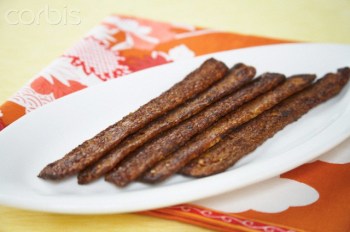
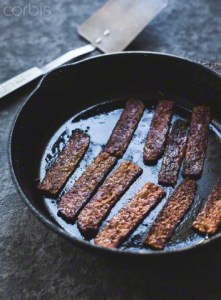
You can transform ordinary tempeh into bacon by using a condiment called Liquid Smoke. Cut the tempeh into thin strips. Place strips in an oiled skillet. Brown tempeh until crispy golden brown. Place tempeh strips on bread, and sprinkle Liquid Smoke over tempeh.
This product looks, smells, tastes, and performs just like real bacon. Each strip is ready to cook. Place strips in oiled skillet, and cook until crisp. Perfect in sandwiches, or salads. This product contains eggwhites.
This condiment has a smoky flavor. It gives bland food a smoke flavor. Whole Foods Market carries it.
Irene Pastore is a native New Yorker, health and fitness blogger, and personal trainer. Irene owns this website, and writes all the blog posts. For her complete bio, visit the About Page.
This post isn’t about Lord Of The Rings, or Star Wars. We are talking about tiny mushrooms, grown in clumps, with long spaghetti-like stems.
Native to China, Japan and Korea, Enoki mushrooms are a good source of Vitamin D, trace minerals, and B-complex vitamins. Enoki’s are eaten raw, or cooked.
Enoki Mushrooms
Enoki mushrooms have firm, white, shiny caps. Another name for them is Golden Needle Mushrooms.
They are a delicate, mildly sweet mushroom, with a crunchy texture. Enoki’s work well in soups, salads, and noodle dishes.
ENOKI MUSHROOM RECIPE SUGGESTIONS
Vegetable Tofu Stir Frys
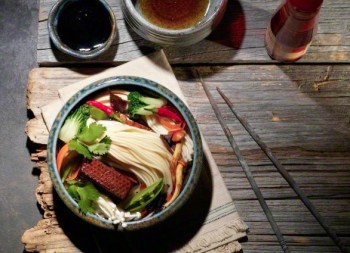
Soba Noodle Soup with Enoki Mushrooms, Bok Choy, Snow Peas, and Tofu
Noodle Bowls
Vegetable Dishes
Raw Salads
Indian Style Dishes
Lentil Dishes
Miso Soup
Sauteed Dishes
Rice Paper Wraps
Irene Pastore is a native New Yorker, health and fitness blogger, and personal trainer. Irene owns this website, and writes all the blog posts. For her complete bio, visit the About Page.
Barley: Barley is a hearty grain that compliments winter meals. Add to soups, and stews, or combine with sautéed onions and celery. Contains gluten.
Corn: Use cornmeal flour to bake delicious muffins, and breads. Corn flour is also used in making pasta. Contains a type of gluten different from that found in wheat.
Kamut: A firm-textured ancient wheat with a nutty, sweet and buttery flavor. Contains gluten.
Farro: An ancient Italian grain that may have sustained the Roman Legions.
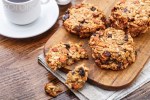
Oatmeal-Raisin Cookies
Farro is used in soups, salads, and desserts. Looks and tastes somewhat like brown rice, with a nutty taste. Farro is also known as Emmer. Contains gluten.
Millet: A tiny grain, that looks like a seed. Use it like rice as a side dish, or in a casserole. Gluten-free.
Oats: A sweet-flavored grain commonly used in preparing warm cereal, and cookies. Oats contain avenin, a protein that may trigger a reaction in celiacs.
Rice: Varieties include Brown, White, Short and Long Grain. Sticky White Rice is used in preparing sushi rolls. White and Brown Basmati is another variety with a rich nutty flavor. Gluten-free.
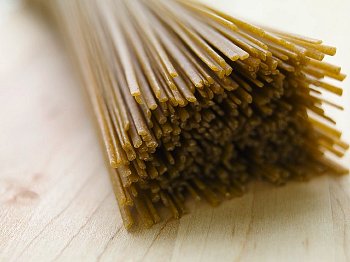
Whole Wheat Linguine
Rye: Rye is a member of the wheat family, and is used in bread making, and Scandinavian crispbreads, and crackers. Contains gluten.
Spelt: An ancient variety of wheat. Spelt produces baked goods lighter in texture and easier to digest than standard wheat. Contains gluten.
Triticale: This grain is a hybrid of rye and wheat. Triticale flour is used to bake muffins, breads, cakes, and crispbreads. Contains gluten.
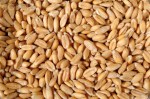
Wheat: The most widely known grain used in baking breads, cookies, cakes, noodles, pasta, and pies. Contains gluten.
SEEDS
The seeds on this list are used the same way as grains. Common uses are breakfast cereals, side dishes, and casseroles. Seeds are available as flour for baking. If you’re wheat intolerant, try using seeds. They’re lighter than wheat, and have their own unique taste.
Amaranth: A very tiny seed used in making breakfast cereal, added to soups and stews. Gluten-free.
Buckwheat: Buy Toasted Buckwheat, or Raw. Use in soups, or as a side dish. Whole Buckwheat flour makes great pancakes. If you don’t mind the dark brown color, buckwheat can be used to make cookies, and sweet breads. Gluten-free.
Quinoa: A small seed, that comes in white, black or red. Add fruit and nuts to Quinoa to make a tasty breakfast porridge Trader Joe’s sells their own brand of penne and fusilli pasta made from Quinoa and Rice. Gluten-free.
Teff: Teff is an ancient seed, cultivated for thousands of years in Abyssinia. Teff seeds are about the same size as a poppy-seed. Teff comes in white, red and dark brown. Teff flour is used to bake breads, and pie crust. The seeds can be steamed, boiled, and baked. Gluten-free.
GRAIN & SEED GALLERY
SPELT GRAINS
RYE BREAD
BROWN RICE GRAINS
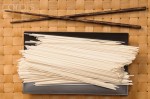
RICE NOODLES
WHOLE WHEAT BREAD
WHEAT GRAINS
MILLET GRAINS
Raw buckwheat seeds
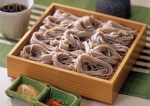
BUCKWHEAT NOODLES
Irene Pastore is a native New Yorker, health and fitness blogger, and personal trainer. Irene owns this website, and writes all the blog posts. For her complete bio, visit the About Page.
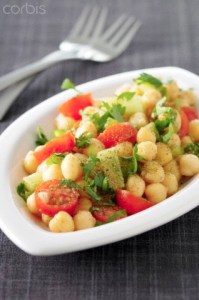
2 Cups Cooked, Drained Garbanzo Beans
2 Cups Cherry Tomatoes. Rinsed and Cut In Half
1 Tablespoon Olive Oil
1 Teaspoon Balsamic Vinegar
2 Tablespoons Fresh Minced Oregano (or 1 Teaspoon Dried)
1/8 Teaspoon Ground Black Pepper
½ Teaspoon Italian Seasoning
Alfalfa Sprouts or Romaine Lettuce
Instructions
In a large salad bowl, combine beans and tomatoes.
In a small bowl, combine olive oil, vinegar, oregano,
pepper, and Italian seasoning.
Beat the ingredients until the oil and vinegar no longer separate, and the mixture is well-blended and thick.
Pour the dressing over the beans and tomatoes, and
mix gently to coat.
Line salad bowls with Alfalfa Sprouts, or Romaine Lettuce. Top with bean mixture, and serve.
Buon Appetito!
Irene Pastore is a native New Yorker, health and fitness blogger, and personal trainer. Irene owns this website, and writes all the blog posts. For her complete bio, visit the About Page.

 Litelife Organic Tempeh


 Irene Pastore is a native New Yorker, health and fitness blogger, and personal trainer. Irene owns this website, and writes all the blog posts. For her complete bio, visit the About Page.




 Irene Pastore Fitness.com