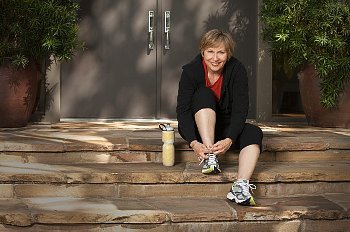
Only 1 in 5 Americans Get Enough Exercise: CDC

Picture brighter for aerobic exercise than for muscle-strengthening, report finds.

HealthDay news image

THURSDAY, May 2 (HealthDay News) — Most Americans are falling short when it comes to exercise, a new government report shows.  Overall, only 20 percent of U.S. adults get the recommended amounts of both of aerobic and muscle-strengthening exercise, according to the U.S. Centers for Disease Control and Prevention.
The news was less disappointing for aerobic exercise, with 51.6 percent of adults getting the recommended amount, than it was for muscle-strengthening activities, with only 29.3 percent getting the recommended amount.The overall exercise rates also varied widely by state, ranging from 13 percent in Tennessee and West Virginia to 27 percent in Colorado.

The researchers put a positive spin on the results.

“While only about 30 percent of adults meet the muscle-strengthening guidelines, we find it very encouraging that half of U.S. adults are meeting the aerobic guidelines,” said report author Carmen Harris, a CDC epidemiologist.

The report was published in the May 3 issue of the Morbidity and Mortality Weekly Report, a CDC publication.

One expert also thinks the findings are good news.

“It is great that more people are participating in regular exercise,” said exercise physiologist Samantha Heller. Continue reading “Only 1 in 5 Americans Get Enough Exercise: CDC”

Quick Tip: 10 Tips To Avoid Injury At The Gym

MACHINE CHEST PRESS

MACHINE CHEST PRESS

WARM-UP

Start your routine with a warm-up.  Spend 10 minutes on a cardio machine, and work up to a light sweat.  

COOL-DOWN: Finish your routine with stretching.  Hold each stretch for 20 seconds.

WEIGHT MACHINES: Most machines have instructions, and illustrations showing proper body alignment.  Read the instructions so that you know how to use each machine.  If you need more help, ask a floor trainer.

LIFTING TECHNIQUE

  • Do not lift more weight than you can handle.  If your face turns beet red, and you can’t breathe, you’re lifting too much weight.  Overexertion leads to injury.
  • Do not swing dumbbells.  When weights are too heavy for your level of strength, you’re going to resort to swinging them instead of lifting.
  • Learn how to control free weights.  Barbells and dumbbells, known as free weights,  are more difficult to use than weight machines, because you have to control the weight while using correct alignment.  An out-of-control barbell is very dangerous to you and the people working around you.
  • If you’re new to lifting, start with machines, not free weights.

SEEK ADVICE

If you need advice, ask a trainer.  Gym members are not a reliable source of information.  Just because they belong to your gym, doesn’t mean they know any more than you do.

GROUP CLASSES

Let your instructor know if you have injuries before the class starts.  Ask their advice on whether the class is suitable for your level.  

PROPER CLOTHING

Always wear athletic footwear when training.  Proper footwear gives your feet support, and protects them from injury.

Copyright 2013 Irene Pastore and Blue Moon Personal Training

Whole Lotta’ Shakin’ Goin’ On

http://www.youtube.com/watch?v=8yRdDnrB5kM

Jerry Lee Lewis, one of the original recording artists on Sun Recordsat the piano in 1957.  As you can see, it’s impossible not to get up and move.  The link will take you to his website, where you can hear more of Jerry’s music on a 50’s jukebox.  Check out Sun for more get up and move classic rock music.

MUSIC – AN EXERCISE MOTIVATOR

Do you know that music can help you start an exercise program?  Just pick the music that you like and get up and start moving.

Admit it, when you’re home alone listening to your favorite tunes, don’t you sometimes get up and dance, when no one can see you?  Sure you do.  Just make it more of a regular habit, and then you’ll get a good cardio workout.

HOME CARDIO DANCE WORKOUTS TIPS

  • While you’re dancing around your living room, don’t overdue it.  Start with five to seven minutes, every other day.
  • Gradually increase your workouts to 10 to 15 minutes.
  • While you’re dancing, you should be able to breath, and carry on a simple conversation.  If you’re face is beet red, and you’re gasping for air, you’re overdoing it.
  • Move furniture, and rugs so you don’t trip over them.  The idea is to get healthy exercise, not a broken leg.
  • As you get stronger, increase your exercise time to 20 to 30 minutes daily.  Don’t rush it.  Too much too soon will wear you down, and you’ll get discouraged.

The exercise described in this post isn’t meant to replace the guidance of a personal trainer, in a live setting. Exercises performed incorrectly may result in injury.

Comment Guidelines

Copyright 2012 Irene Pastore and Blue Moon Personal Training

Quick Tip: Walk 150 Minutes Per Week

Most Americans have miles to go, before they walk enough to stay healthy, says the

150 Minutes Weekly = 20 Minutes Daily
You Can Do It!

Center For Disease Control and Prevention (CDC). The CDC  recommends 150 minutes per week of aerobic activity, and for most people that’s as simple as a brisk walk 20 minutes daily.  Click here to listen to a short audio clip, and to read the news article “A Bit Better Walking,” from Healthfinder.gov.

Comment Guidelines

Copyright 2012 Irene Pastore and Blue Moon Personal Training

How To Avoid Overuse Injuries

WHAT IS AN OVERUSE INJURY?
An overuse injury is a chronic irritation to a body part. Other names for overuse injuries are repetitive stress injuries, and cumulative trauma injuries.  Unlike acute injuries that are caused by a single traumatic event, overuse injuries happen over time.  An overuse injury may involve tendons, bones, joints, or muscles. Continue reading “How To Avoid Overuse Injuries”