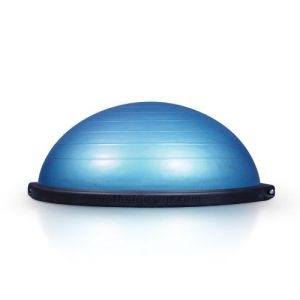
Home Fitness: The BOSU Balance Trainer

Category: Core Strength, Balance, Stability, Cardio, Warm-Ups

How To Use It: Balance exercises are performed while standing on the BOSU Trainer.

Type Of Workout: Total Body that includes seated, standing, prone, and supine.  

Portability: The BOSU Balance Trainer is used on the flat or round sides.  The round side is less stable and provides more challenge as you advance through your exercise routine.  BOSU activates the core muscles.  May include an exercise chart with purchase. If not, there are DVDs on the market.

The BOSU measures 24.6″ x 24.6″ x 6″.  It has a flat sturdy base. 

Benefits: Cost effective method to improve balance by activating the core. Nice addition to a home gym. Lies flat and stores easily in a closet or drawer. May include exercise chart with purchase.

Great addition for your home gym, since it doesn’t take up much room.  Versatile.  You can get a total body strenuous workout on the BOSU Balance Trainer.  Different models available to suit your fitness goals. 


The BOSU Balance Trainer Is Available on Amazon. Follow This Link for More Details.

Virtual Fitness: How To Do BOSU Lateral Crossovers

INSTRUCTIONS: Begin on either left or right foot. Warm-up by taking a few small lateral crossovers in the opposite direction. Slowly increase the tempo and make the crossovers wider, for a total of 10 repetitions. Then change the exercise by laterally crossing over the entire BOSU for a total of 5 repetitions. Switch sides and repeat the entire routine. Avoid leaning forward and maintain an upright position. As you reach the end of the exercise, cool down by slowing your pace.
EXERCISE GOAL: The Lateral Crossovers provide a warm-up for strength training, or stretching, or as part of a cardio circuit training routine
BENEFITS: The Lateral Crossovers improve core strength, heart health, stamina, coordination, and agility.
MODIFICATIONS: 1) Do fewer repetitions. 2) Make the crossovers less wide. 3) Slow your pace.

EXERCISE DOs and DONTs – As with all exercise programs, when using exercise videos that appear on this site, you need to use common sense. If your muscles are weak, either do the modifications, or don’t attempt this exercise if it’s too difficult for you. When starting an exercise program, be sure to discuss your plans with your healthcare provider

Virtual Fitness: How To Do BOSU Single Leg Jumps

The BOSU Single Leg Jump is a heart pumping exercise that strengthens the core, improves agility and balance, while working the shoulders, thighs and legs. The Single Leg BOSU Jump is more difficult than BOSU Lateral Jumps, as it requires greater agility and balance.
INSTRUCTIONS: Step up to the BOSU on left foot and take 3 lateral jumps from BOSU to floor to BOSU. Repeat for 3 rounds. Then jump from BOSU to BOSU for 3 to 4 rounds. Switch to your right foot and repeat the routine. Keep knees slightly bent during the exercise. Hold arms outward to assist with balance.
Avoid leaning forward, and maintain a steady pace as you jump. The point is to control the exercise. Faster isn’t always better. Start the exercise with a slow warm-up, and finish with a cool-down by slowing your pace to a gradual stop.
WHY YOU SHOULD DO THIS EXERCISE: Single Leg Jumps are suitable as a warm-up prior to strength training, or as part of a cardio circuit training routine. You can also use it to recharge your energy, while taking a break from your laptop.
MODIFICATIONS: 1) No BOSU? No problem. Do the Single Leg Jumps on the floor, while using the same movement pattern. You can also substitute the BOSU with a Foam Cushion. Similar to the BOSU, the cushion isn’t stable, but not as difficult as the BOSU. 2) Allow opposite foot to touch the floor to assist with balance.

EXERCISE DOs and DONTs – As with all exercise programs, when using exercise videos that appear on this site, you need to use common sense. If your muscles are weak, either do the modifications, or don’t attempt this exercise if it’s too difficult for you. When starting an exercise program, be sure to discuss your plans with your healthcare provider

Virtual Fitness: How To Do BOSU Lateral Jumps

The BOSU Lateral Jump is a heart pumping exercise that strengthens the core, improves agility and balance, while working the shoulders, thighs and legs.
INSTRUCTIONS: Bend knees slightly and start with a slow pace warm-up. Gradually increase the tempo. Avoid leaning forward and maintain an upright posture. Stay in control of the exercise. Poor control will tire you out. To cool down, begin to move slower until you come to a stop.
WHY YOU SHOULD DO THIS EXERCISE: Lateral Jumps are suitable for a warm-up prior to strength training, or as part of a cardio circuit training routine. Or just use it to recharge while taking a break from your laptop.
MODIFICATIONS: 1) No BOSU? No problem. Do Lateral Jumps on the floor, while using the same movement pattern. You can also substitute the BOSU with a Foam Cushion. Similar to the BOSU, the cushion isn’t stable, but it isn’t as difficult as the BOSU. 2) Don’t move arms back and forth. You can also keep them at your sides instead of bending at the elbows.

EXERCISE DOs and DONTs – As with all exercise programs, when using exercise videos that appear on this site, you need to use common sense. If your muscles are weak, either do the modifications, or don’t attempt this exercise if it’s too difficult for you. When starting an exercise program, be sure to discuss your plans with your healthcare provider

Virtual Fitness: How To Do Buddy Jumping Jacks

Jumping Jacks Get Your Heart Pumping And Your Muscles Warmed Up
Buddy Jumping Jacks can be done side-by-side as shown in the video or facing one another in a mirror image. Set either a slow, medium or quick tempo. Stay within your Target Heart Rate Range.
Buddy Jumping Jacks are used either as a warm-up, or part of your workout. It builds shoulder and cardiovascular strength.

EXERCISE DOs and DONTs – As with all exercise programs, when using exercise videos that appear on this site, you need to use common sense. If your muscles are weak, either do the modifications, or don’t attempt this exercise if it’s too difficult for you. When starting an exercise program, be sure to discuss your plans with your healthcare provider