Instructions: Begin on all fours. Align wrists under shoulders, and knees under hips. Stretch hands open. Keep your body steady throughout the pose. Extend the right leg and left arm. Slowly reach back with your left hand, and grab your right ankle. Lift the right leg. Look upward. The model in the video is curling her toes under, but you can also do this pose by keeping your feet flat. Balancing is more challenging when you curl the toes under.
Cautions: You can lose your balance if you’re muscles are tight. Reaching back and grabbing the ankle is difficult for many people. Either do the modification, or skip this pose until you’ve developed more flexibility.
Benefits: The Balanced Bow Pose is a backward bend, and therefore strengthens spinal muscles that initiate this type of movement. The backside (gluteus maximus) is strengthened. The abdominals, inner hips and chest are stretched. Core stabilization is required to perform this pose without loss of balance.
Modifications: 1) Instead of your hand, lean on your forearm with your elbow aligned under your shoulder. 2) After grabbing your ankle, don’t lift your leg higher. 3) Look down with your neck long. Variation: Keep both feet flat, instead of curling your toes under.
EXERCISE DOs and DONTs – As with all exercise programs, when using exercise videos that appear on this site, you need to use common sense. If your muscles are weak, either do the modifications, or don’t attempt this exercise if it’s too difficult for you. When starting an exercise program, be sure to discuss your plans with your healthcare provider
Benefits of Crescent Moon Pose: This kneeling pose is a backward bend that strengthens core muscles, since it challenges your balance. It stretches the abdominals and strengthens spinal muscles that are important in this movement. This pose also stretches the inner hips. It strengthens the front deltoid (shoulder) muscle, as the arms are lifted upwards.
Modifications For Crescent Moon Pose: The model shown in this video has considerable flexibility inside her hips, so that she can bring her left leg into the position you see in the video. If you do not have this level of flexibility, position your knee under your hip, instead of taking it as far back as shown here. Lift your arms very slowly to ensure good balance.
EXERCISE DOs and DONTs – As with all exercise programs, when using exercise videos that appear on this site, you need to use common sense. If your muscles are weak, either do the modifications, or don’t attempt this exercise if it’s too difficult for you. When starting an exercise program, be sure to discuss your plans with your healthcare provider
EXERCISE DOs and DONTs: As with all exercise programs, when using exercise videos that appear on this site, you need to use common sense. The Yoga exercise is this video is not recommended for those who are sedentary, or who are beginners. Don’t attempt this Yoga sequence, if it’s too difficult for you. When starting an exercise program, be sure to discuss your plans with your healthcare provider.
Got an achy back? You’re not alone. Back pain is the number 2 reason for doctor visits, and one of the most common reasons for missed work.
What should you do if your back hurts all the time? First, check with your doctor to find out whether your back ache is caused by daily habits, muscular weakness, or an accident.
If your doctor tells you there is structural damage to bone, ligament, tendon or muscle, he/she may prescribe medication, and/or a treatment plan.
If your doctor discovers that the reason for your back pain is muscular weakness, or daily habits, and that participating in regular exercise will help, then you can begin doing exercise.
FOUR STEP BACK SOLUTION
1) Stretch your back with Yoga poses, or Pilates exercises.
2) Strengthen your core muscles, especially the abdominal, and back muscles. Muscles work in pairs. That’s why they should be strengthened, and stretched in equal measure.
3) Avoid sleeping on your stomach. When you sleep on your stomach, your pelvis tips forward, tightening the low back muscles. In the morning you’ll wake up with a backache. Instead, sleep on your side, or on your back.
While you sleep on your back, place a pillow under your knees to help stretch your back muscles. While sleeping on your side, place a pillow between your knees to ease your low back.
4) Practice the pelvic tilting exercise. This exercise stretches your low back muscles. Pelvic tilting can be done while standing against a wall, lying on your back, or seated on a chair, or on an exercise ball.
Irene Pastore is a native New Yorker, health and fitness blogger, and personal trainer. Irene owns this website, and writes all the blog posts. For her complete bio, visit the About Page.
With the exception of a few urban areas, we live in a country that encourages sitting, because our towns and cities are planned around the automobile.
We sit at the computer, in front of the TV, on the job, at the movies, dining out, and commuting to work. .
Hamstring Stretch
In many cities and towns, sidewalks are inadequate for pedestrians, making the car an absolute necessity, even for short, walkable errands.
Prolonged sitting weakens our muscles, makes us lethargic, creates a weak core, which in turn, develops poor posture. Medical doctors consider sitting to be the new smoking.
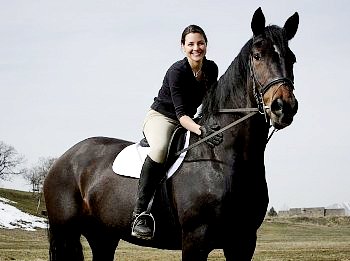
Do you have a job where you’re sitting most of the day? Do you have chronic low back pain? Does your neck feel stiff? Are your muscles so sore you can’t sit down? Is the time spent riding your horse not as enjoyable as you’d like it to be?
Targeted exercise provides solutions to remedy these problems.
EQUESTRIAN FITNESS AND CORE MUSCLES
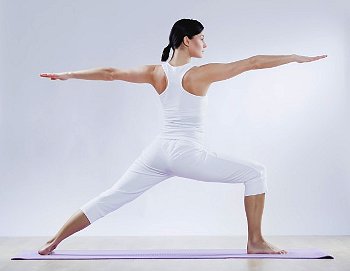
Yoga Warrior 2 Hip Stretch
The muscles of the abs, back, pelvis and hips, make up the core. Strengthening these muscles is important, because the core stabilizes the spine, and protects it from injury,
While you’re moving, the core controls the position and motion of the torso over the pelvis. A strong core improves sports performance, and maintains healthy posture.
SOLUTIONS
Pilates Ab Exercise
Targeted exercise provides solutions to help you get rid of muscular tension, and weakness, develop better posture on and off the horse, and makes riding more effective.
PILATES EXERCISE
Pilates Mat and Reformer exercises are designed to make your core muscles strong.
If you’re not inclined towards Pilates, no worries, you can opt in to a fitness-based core exercise routine, using specialized core equipment to get the job done. Core exercises can also be performed without any equipment.
YOGA CORE EXERCISE
If you’re a Yoga fan, there are many poses that will strengthen your core muscles, stretch your Psoas, Back, and Hamstrings.
As you can see, there are many ways to stretch and strengthen your muscles. Here are a few suggestions.
Stretch the Psoas Muscle because this inner hip muscle tightens up when you do alot of sitting. Stretch your Back to release tension in tight muscles.
Yoga Back Stretch
The Hamstrings are the muscles of the posterior thigh. Theses muscles tighten up from excessive sitting. If you frequently do stair climbing, or cycling ,you should be stretching your Hamstrings on a regular basis.
Strengthen ;your Back and Abdominal Muscles, because these muscles work as a team to keep your posture healthy, and your spine well-supported.
Copyright 2015 Irene Pastore and Tour De Core Personal Training
Riding is a strenuous sport that requires the equestrian to maintain a neutral spine, while sitting in the English or Western saddle.
The saddle, is literally a backless chair, offering no support for the spine. The rider must generate support using strong core muscles.
Little needs to be said about the debilitating effects of back pain for equestrians. No one wants to, or should ride, when in pain. The more uncomfortable you are, the less you’ll be able to enjoy being with your horse. He’ll miss you too.
Learning what causes back pain, and taking preventive measures, will bring many happy riding years. The easiest, and most cost-effective solution, is exercise.
PREVENTION THROUGH CORE TRAINING EXERCISE
Regular exercise is highly recommended for prevention of back pain, and maintaining a healthy back.
Pilates and Yoga keeps riders both strong and flexible. Pilates strengthens your back and abs, Yoga stretches critical areas important for riding, as well as developing tranquility.
Fitness-derived core exercisesare an excellent method to strengthen and stretch muscles that are vital for riders.
COMMON CAUSES OF BACK PAIN
Muscle spasm
Awkward twisting, or bending motions
Incorrect lifting a heavy object
Spinal trauma
Bending down and abrupt turning around
Muscle imbalance
Coughing or sneezing
Prolonged sitting
Sports injuries
Aging
Overweight and obesity
Poor sitting or standing posture
Arthritis
FACTS ABOUT BACK PAIN
Back Pain is one of the most common causes of doctor’s visits in the United States
Back Pain affects most people at least once during their lifetime.
Untreated back pain can make daily activities difficult or impossible.
Back pain affects about 60 to 80 percent of American adults,
More than 26 million Americans between the ages of 20-64 experience frequent back pain.
Back pain is one of the most common reasons for missed work.
Low back pain is the single leading cause of disability worldwide.
Americans spend at least $50 billion yearly on back pain.
From the American Chiropractic Association and The American Academy of Pain Medicine
STANDARD MEDICAL SOLUTIONS
Over-the counter pain relievers
Hot or cold packs
Exercise
Medication
Physical therapy
Complementary or alternative treatments
Injections
Surgery
Copyright 2014 Irene Pastore and Tour De Core Personal Training

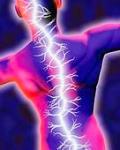 Got an achy back? You’re not alone. Back pain is the number 2 reason for doctor visits, and one of the most common reasons for missed work.
 muscular weakness, or daily habits, and that participating in regular exercise will help, then you can begin doing exercise.
 While you sleep on your back, place a pillow under your knees to help stretch your back muscles. While sleeping on your side, place a pillow between your knees to ease your low back.
 Irene Pastore is a native New Yorker, health and fitness blogger, and personal trainer. Irene owns this website, and writes all the blog posts. For her complete bio, visit the


 Irene Pastore Fitness.com