Giving up on Pilates

Why People Quit Pilates
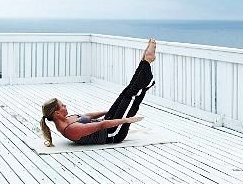
The Pilates Hundred exercise might be too difficult for beginners.

You’ve tried a group class, and couldn’t do the exercises.  Your neck hurt, and you couldn’t keep your head off the mat.  Your hamstrings are so tight that you couldn’t straighten your legs.  You were out of breath. Everything hurt.  You couldn’t wait for the class to end.

If you had an experience like this, the class you took was much too difficult.  Maybe it was the only one offered at your gym, and you decided to try it.  But now, your never going back.  No wonder you quit.

How To Enjoy Learning Pilates

There’s a better way to begin Pilates.  Here are a few suggestions.

  • Find a Pilates studio, or gym that offers basic classes.  Call the studio, describe your needs.  Find  out whether they teach your fitness level.  
  • Find a Pilates trainer who has a studio, or will visit your home for private instruction.
  • Purchase a beginner level DVD.  Amazon.com is a good place to start because of their large inventory.
  • Purchase a Pilates book that illustrates exercise modifications.
  • Find on online membership-based Pilates studio that offers basic classes.
  • When you take classes, be sure to listen carefully to instructions.
  • Don’t overdo it.

When To Hire A Pilates Trainer

Group exercise isn’t for everyone, especially if you’ve been injured, have special needs, or you’ve been sedentary.

Pilates Spine Supporter
The Pilates Spine Supporter is used to modify The Hundred exercise.

A qualified trainer will save you time and money by teaching you correct alignment, and how to modify exercises that are too difficult.  They will take you step-by-step through each exercise according to your ability, and help you avoid injury.

A trainer will demonstrate the use of specialized Pilates equipment, such as the Spine Supporter, and the Pilates band.

The band helps you develop stronger abdominals and neck muscles during the supine Roll-Up, without straining yourself.

The Spine Supporter develops abdominal strength, and reduces tension in your neck during the Double Leg Stretch exercise.

At some point, you might be ready to join a group class.  So, don’t give up.  If you stay with it, you’ll succeed.

 Copyright 2013 Irene Pastore and Blue Moon Personal Training
Exercise of the Month: June 2013

WARRIOR TWO YOGA POSE 

Start Position
Warrior II

Sanskrit Name: Virabhadrasana

Level: Warrior II is a basic standing Yoga pose.  

Reverse Warrior is an intermediate level, standing Yoga pose.

Equipment: Yoga sticky mat.

Muscles Worked Warrior II: Strengthens shoulders, hamstrings, hip abductors, and external rotators.  Stretches quadriceps, hips (iliopsoas, and adductors).

Reverse Warrior stretches the oblique abdominals, while strengthening the legs, and opening the hips.

How to Perform the Warrior Two Yoga Pose

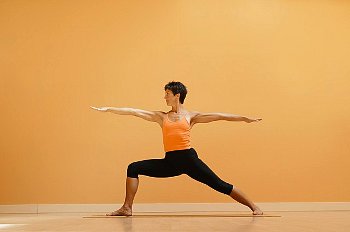
Turn your right foot to the right, and step your feet wide apart, as shown in the photograph of Warrior II Pose.  Your hips and shoulders form a rectangle.

Raise both arms to shoulder height keeping wrists straight. Turn your head to the right, gazing at your fingertips.

Distribute your weight evenly over both legs.  Hold 20 to 30 seconds.

Reverse Warrior Pose

Variation: Reverse Warrior (Viparita Virabhadrasana).  This is a more challenging variation of the Warrior II Pose.  

Set up is the same as Warrior II.  The difference is adding a side bend while raising the arm.  

Distribute your weight evenly over both legs. Your hand should rest gently on your leg.  

Gaze upward at your open palm.

Caution: To prevent slipping, remain centered on your mat. Avoid poses that are uncomfortable for your body.  You should be able to breath deeply without forcing the flow of your breath.

Copyright 2013 Irene Pastore and Blue Moon Personal Training

Recommended Product: Autobiography of a Yogi

Swami Yogananda
Swami Yogananda

First published in 1946, by the Self Realization Fellowship, Autobiography of a Yogi, is the life story of Paramahansa Yogananda, one of the world’s most well-known teachers of Yoga science. Since its first printing, the book has sold over 4 million copies.

Autobiography of a Yogi describes Yogananda’s spiritual journey, and his search for enlightenment.  He was born in India in 1893, and in 1915 became a monastic.  Yogananda moved to the United States in 1920, where he founded the Self-Realization Fellowship to disseminate his teachings.

Autobiography of a Yogi is an inspiration for anyone considering the spiritual path, or for those already on their way.  It will make an excellent gift for Yoga lovers.

Visit the Self Realization Fellowship website to read more about Yogananda’s teaching.  The SRF web bookstore sells his books and CDs.

Copyright 2013 Irene Pastore and Blue Moon Personal Training
The Lunge Stretch for Tight Hips

The Lunge Stretch

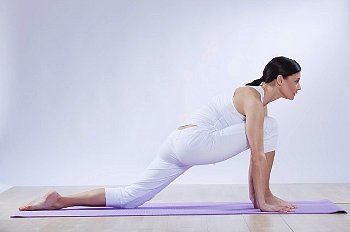
This is an excellent basic stretch to help open the hips. If you practice Yoga and have difficulty with hip openers, make the Lunge Stretch part of your regular stretching routine.  This stretch targets the iliopsoas muscle.

Lunge Stretch
Lunge Stretch

How To Do the Lunge Stretch

  1. Get onto all fours.
  2. Bring your right leg forward within your ability. You may have to align your right knee directly under your right hip, unless you have more flexibility, and can bring your leg further back.
  3. Place your hands on either side of your right foot.
  4. Hold the Lunge Stretch for 15 to 20 seconds.
  5. Repeat the stretch on the left side.

How To Modify the Lunch Stretch

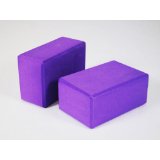
  • If you have difficulty reaching the mat, place a Yoga block under each hand.
  • Place a folded towel under your knee for added cushioning.
Yoga Blocks
Yoga Blocks

 Copyright 2013 Irene Pastore and Tour De Core Personal Training

400 Pound Woman Gets Skinny

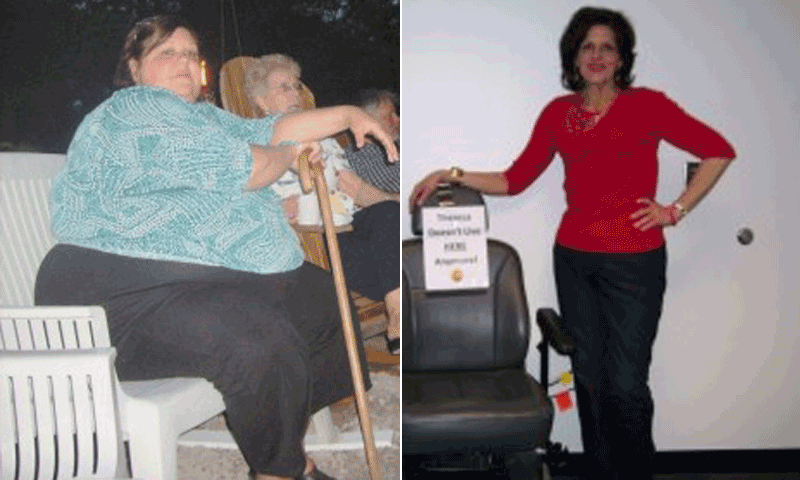
Before at 400 and after at 152 pounds.

Are you stuck in a rut about losing weight?  Do you think it’s impossible to shed fat, especially if you weigh hundreds of pounds over your normal limit?

I’ve got news for you, there are plenty of people in your boat.

Many of them reached a breaking point, and made the decision to turn their lives around.

For some the tipping point is fear, for others it’s a medical scare, and others are literally sick and tired of being fat.

Here’s a news story about 49 year-old wheel-chair bound Theresa Borawski, who weighed over 400 pounds before deciding to change her eating habits, and lost 276 pounds in the process.

Her method was cutting back on calories, and eliminating junk food.   Theresa got down to 152 pounds, and no longer needs a wheel chair or cane for mobility. Her blood pressure has stabilized, and her medications have been reduced.

If she can do it, so can you.  Read the entire story at Huffington Post.

Copyright 2013 Irene Pastore and Blue Moon Personal Training
Muscle Imbalance: Tight Iliopsoas and Weak Gluteals

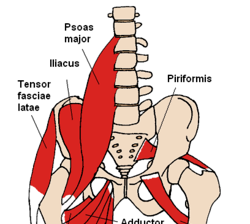
Psoas and Iliacus Muscles

Opposite Muscles Work Together

Muscles work in opposite pairs.  Ideally both pairs should be equal in strength and flexibility.  

A pair of  muscles has opposite functions.  The iliopsoas and gluteals are opposing muscles.

The iliacus and psoas are two muscles that comprise the iliopsoas, a hip flexor, and low back stabilizer.

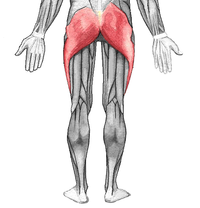
The iliopsoas brings your hips forward, while the gluteals bring your hips backward.

To get an idea how these muscles work together, stand up and swing one leg forward and back without bending your knee.

If your iliopsoas becomes excessively tight, your gluteals become lengthened, and can’t do their job.  The imbalance affects the positioning of your pelvis, and the lower portion of your spine.

Pelvic Stabilization Improves Your Posture

When the iliopsoas and gluteals are working properly, they help to stabilize the pelvis and keep it in a neutral position.  That means, your spine is balanced and healthy.  Poor posture develops when the spine is not in neutral.

Why the Iliopsoas Muscle Becomes Tight

Gluteal Muscles
  • Long hours of sitting at the computer, in a car, or watching television.
  • Sleeping in the fetal position (legs drawn up toward chest).
  • Cycling.
  • Running.
  • Neglecting to stretch.

What Happens When Muscles Become Imbalanced

  • Low back pain
  • Neck pain
  • Sports injuries
  • Poor sports performance
  • Restricted range of motion
  • Poor Posture such as swayback (flattening of the lower back), hyperlordosis, (excessive arch in lower back), flatback (natural low back curve is flat), and kyphosis (excessive arch in upper spine).

When the iliopsoas overpowers the gluteals, the pelvis is tilted forward increasing the arch in the low back. 

Returning Muscle Balance With Pilates

Human posture is considered healthy when the pelvis is in a neutral position, not tipped forward or back.  From the side, the spine has three gentle curves (cervical/neck, thoracic/upperback, and lumbar/low back).  When viewed from the back, the spinal column appears like a straight line.  A healthy spine is pain-free.

  • Pilates exercises are specific to correcting muscle imbalance, by returning the spine to its normal position.
  • Pilates exercises are performed while maintaining the spine in neutral position.
  • Participants who have difficulty holding the spine in neutral, are given modified exercises to help correct muscle imbalance.
  • Special Pilates props and equipment are used, when participants experience difficulty performing the exercises.

Copyright 2013 Irene Pastore and Blue Moon Personal Training